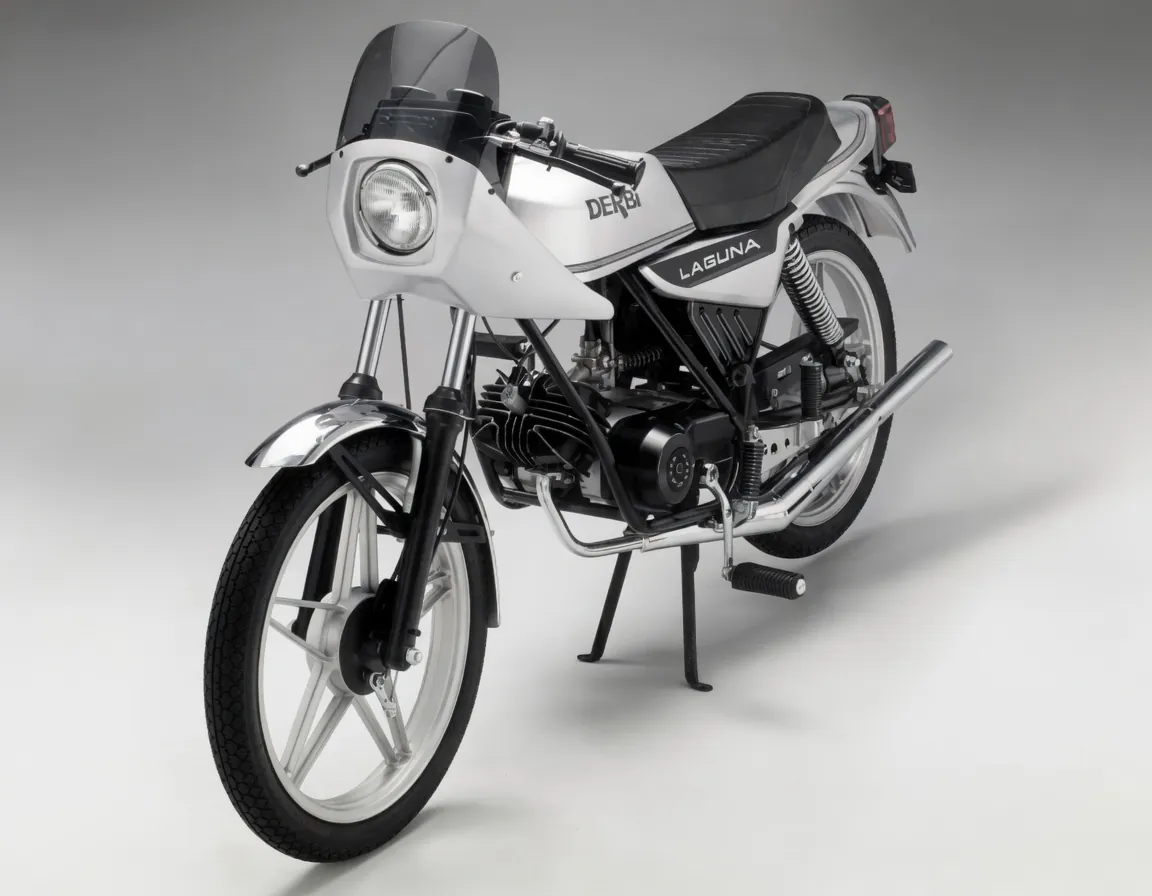
The Derbi Variant is a Spanish classic pedal automatic moped from the late 1970s onward — named for its variator. Drive lock: centrifugal clutch + V-belt variator + final chain. That is the same class as the Peugeot 103 / Motobécane 50V (variator mopeds we cover on this site) — not a modern CVT scooter and not a Minarelli V1 (V1 = single-speed centrifugal-in-bell, chain-only).
Company history — Rabasa to Piaggio
Secondary histories place Derbi in Spain under the Rabasa family, with production commonly associated with Mollet / Nacional Motor. The Variant arrives as a late-1970s ciclomotor for automatic riders who still wanted pedals and a chain final drive. In 2001, secondary accounts place Derbi under the Piaggio group — later badge history is out of scope here.
Derbi’s European racing reputation is real, but this hub will not invent podium lists or mph claims. The useful fact is the name: variable-ratio primary, not a fixed single-speed bell alone.
Piston-port vs pyramid reed vs flat reed
- Early Variant (usual case for this page): piston-port induction.
- Pyramid reed: case-inducted reed family in the same early stroke story — still not flat-reed.
- Flat reed (later): redesigned family. Do not mix flat-reed parts, stroke, or rotation with early Variant piston-port. Field clues (engine/swingarm moving with suspension vs rigid mount) are only clues — stamp-check.
US-market cousins (Laguna / other badges) exist; identify by stamp before ordering intakes or tops.
Piston-port starting points (verify in manual)
From Derbi Variant piston-port spec references — all starting points — verify in your manual:
- Bore/stroke about 38 × 43 mm; displacement about 48.7 cc; compression often listed 8.5:1; magneto rotation commonly CCW facing the magneto.
- Stock carb commonly Dell’Orto 12/12 with main jet often listed #52 — treat as a starting point, then plug-chop.
- Ignition: timing often listed about 1.8 mm BTDC (~21°); points gap about 0.35–0.4 mm; plug commonly NGK B7HS (Champion L82 also cited).
- Transmission / case oil: capacity often listed about 400 cc to the fill hole under the pedal shaft — grade per manual (period notes mention SAE 80 EP or 20W-50; do not guess substitutes).
- Final drive: chain commonly 415; sprockets often listed 20T / 30T front/rear — verify on your bike.
Belt, rollers/weights, and clutch condition matter as much as the carb. Check crank seals and warm compression before a louder pipe. Premix ratio: confirm in your manual.
US ownership gotchas
- US examples are uncommon; expect EU/specialist parts waits.
- Do not order Minarelli V1 or Puch E50 kits as Variant bolt-ons.
- Flat-reed vs piston-port mix-ups waste money.
- Legal class: US moped laws (not legal advice — verify with your DMV; laws change).
Performance posture
Healthy seals, belt, and clutch before pipes. No mph hype, no shop names. Airflow/exhaust changes → plug-chop via carb jetting; start from the #52-class note above only as a labeled starting point. Lean mixtures seize top ends.
Buying checklist
- Warm compression vs a known-good runner; turns freely.
- Identify piston-port vs reed family before pricing parts.
- Belt, rollers, clutch; chain and sprockets.
- Frame rust; title / VIN match.
- Budget carb clean, plug, fuel lines, belt inspection — buying guide.
Related on MopedMasters
- All 25 classic mopeds
- Manuals & PDFs
- Guides hub
- Troubleshooting
- Carb jetting
- Two-stroke oil
- Moped vs scooter
- Same drive class: Peugeot 103 / Motobécane 50V (variator) — still not this bike
FAQ
- Is the Derbi Variant a scooter?
- No. Classic pedal automatic moped: centrifugal clutch, V-belt variator, chain final drive — same drive class as the other variator mopeds on this site, not a modern CVT scooter.
- Is it a Minarelli V1?
- No. V1 is single-speed centrifugal-in-bell without this variator primary.
- What jet should I start with?
- Piston-port pack commonly lists Dell’Orto 12/12 main #52 as a starting point — verify in your manual and plug-chop. Not a guarantee.
- Where should I start after buying one?
- Identify engine family, fresh fuel/plug/lines, belt/clutch check, careful first ride. Then maintenance and manuals.