Engine ID — M48 vs everything else
The Anker-Laura M48 is a 48cc piston-port single-speed with a V-belt primary and automatic centrifugal clutch. On Batavus it usually lives under a motorcycle-style top tank — HS-50, VA, MoBat, Bingo, Badger, and Bronco are the US names you'll see most.
| You see… | Probably… | Not… |
|---|---|---|
| V-belt off crank, single speed, Encarwi carb | Laura M48 | Sachs 504/505 |
| "Laura" casting on cases, 48cc | M48 family | Peugeot 103 |
| Batavus Mk 4S later bike | Sachs engine | M48 |
| Batavus Gran Prix | Peugeot 103 | M48 |
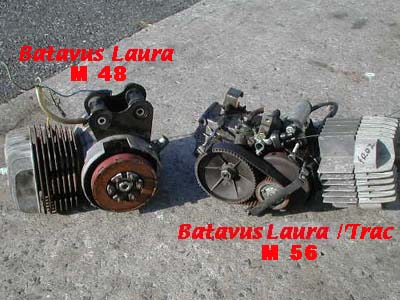
| Trac / Daelim M56 | Laura M56 clone | Same gaskets as M48 |
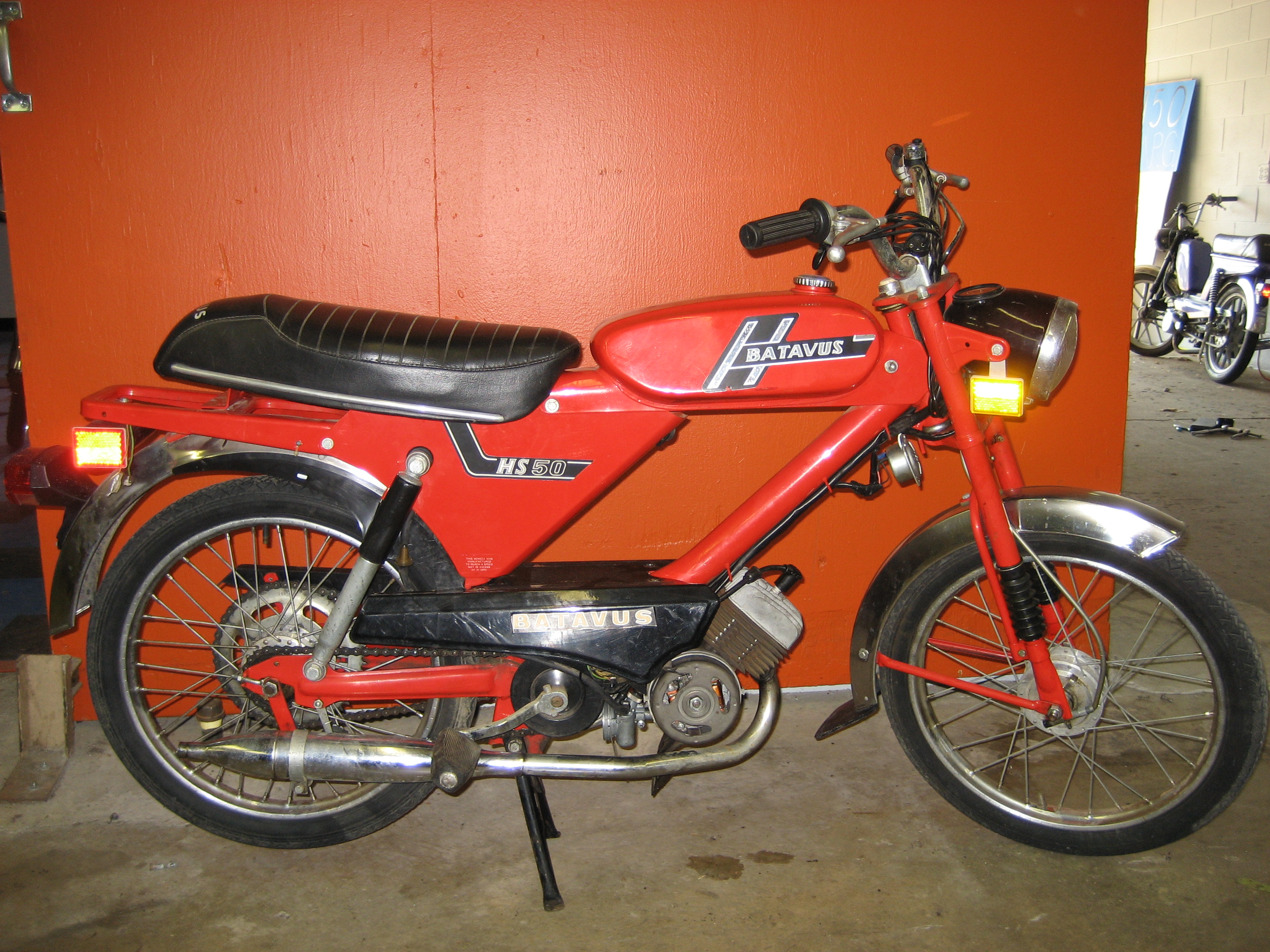
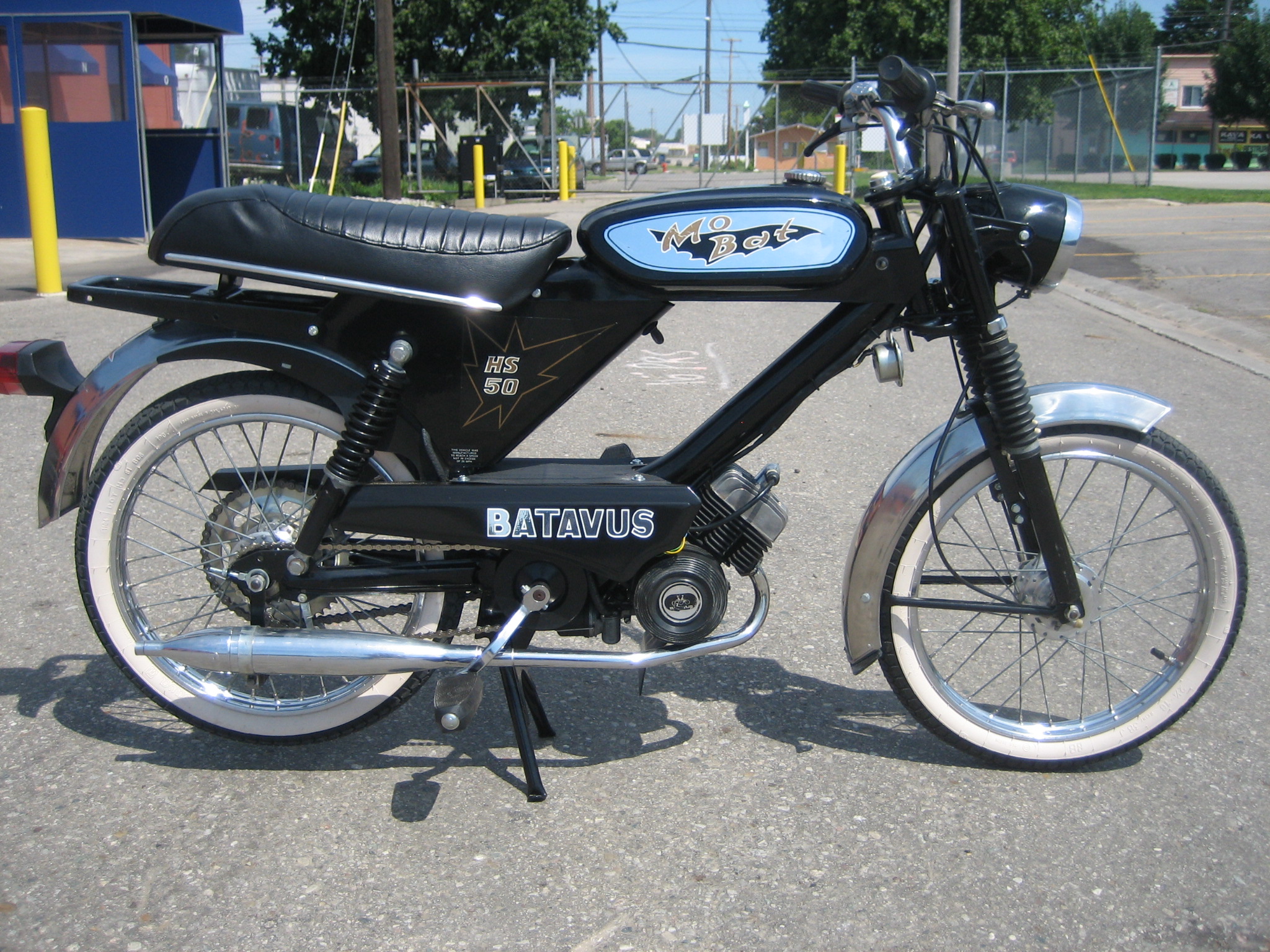
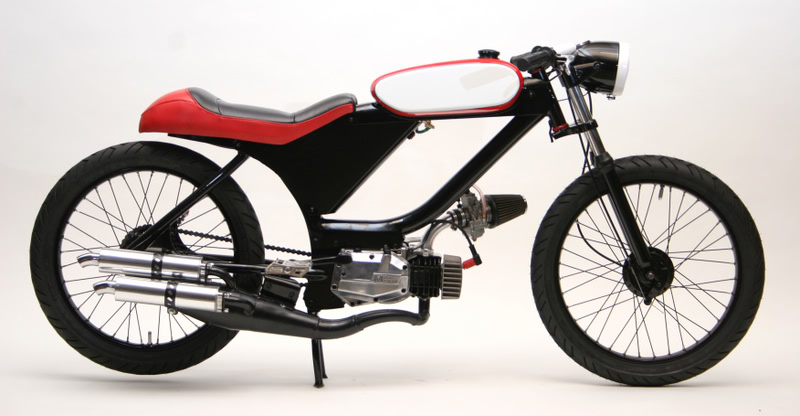
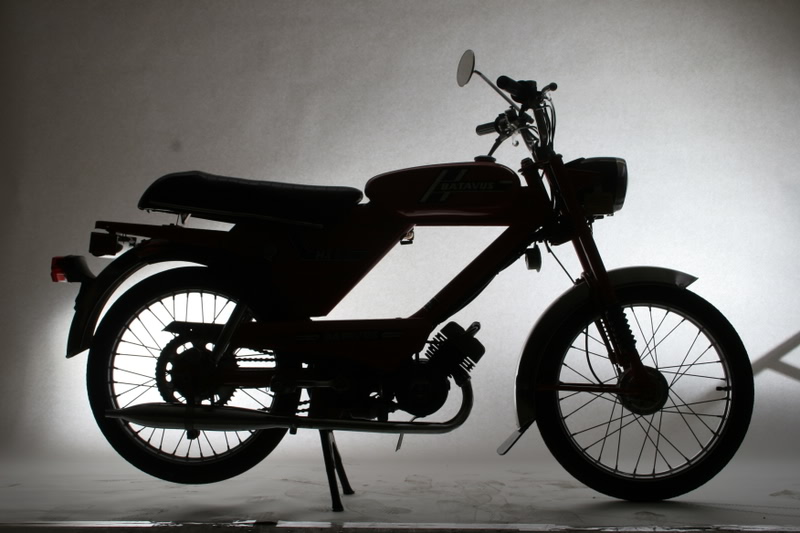
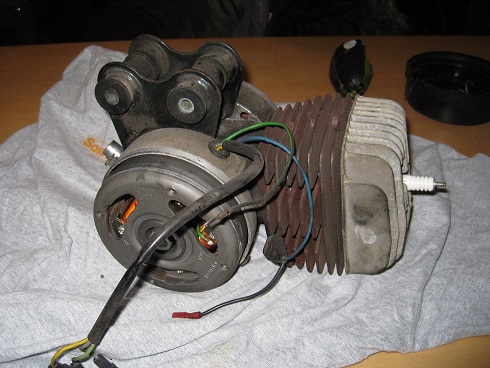
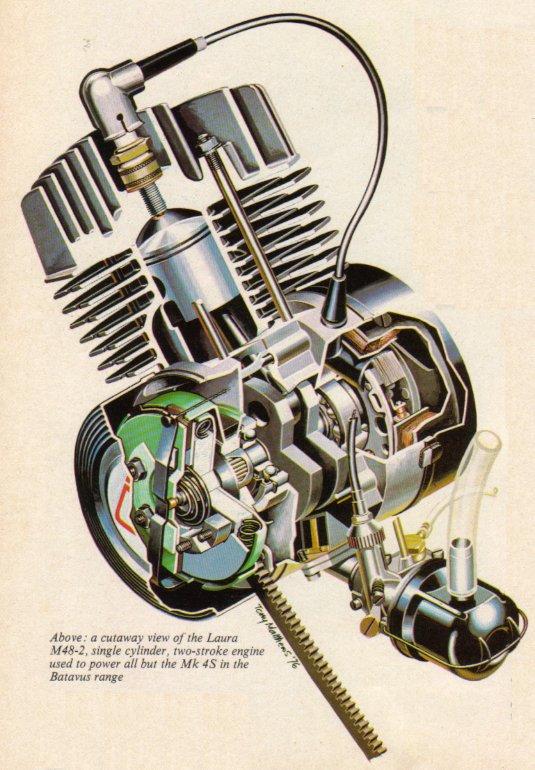
US Batavus models — M48 family
Eight US-market Batavus models ran the Laura M48 (48 cc, V-belt, auto clutch). Watch for engine swaps: Mk 4S = Sachs; Gran Prix / Mondial = Peugeot 103; some Regency / Starflite = Laura M56 (toothed belt — different parts).
| US M48 models | Notes from wiki |
|---|---|
| VA Standard | Step-through; 0.95 gal tank; ~$429 (1970s); red/yellow/orange/violet |
| VA Deluxe | Turn signals + rack-mounted battery; ~$459 |
| HS-50 | Top-tank motorcycle styling; 1.3 gal; turn signals; red only; ~105 lb |
| MoBat | Black HS-50 twin — stylized MoBat logo on tank |
| Bingo, Badger, Bronco | Step-through M48 variants |
| Some Starflites | M48 or M56 depending on year — verify belt type before ordering parts |
M48 vs M56: piston, reed valves, and certain clutch parts interchange; cases, belts, and most gaskets do not. M56 is slightly faster (toothed belt + dry clutch).
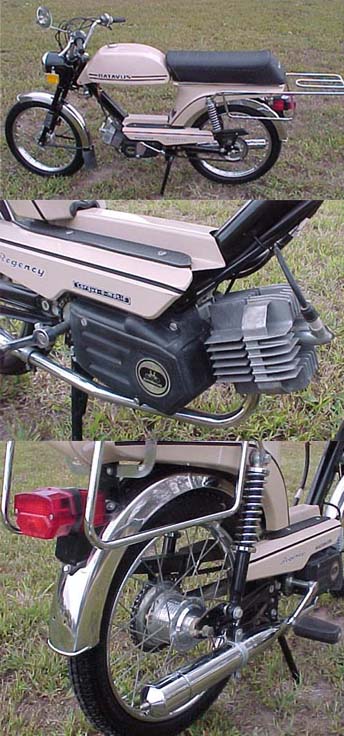
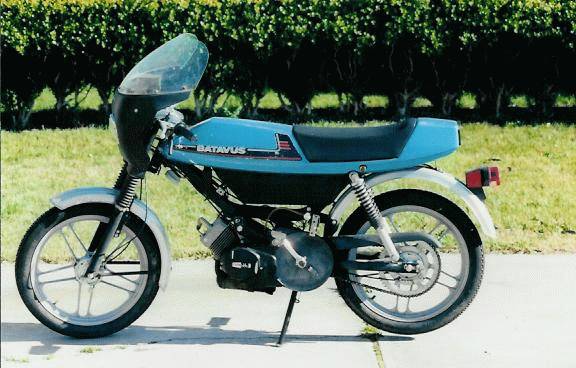
HS-50 — belt, filter, handling
Stock HS-50: 35 mph, 1½ gal tank, ~90 lb. Twitchy off the line — centrifugal clutch and chain drive — then pulls hard once the band hits. Geared mopeds win the drag race; the Batavus wins the chase.
V-belt cross-reference
| Brand | Part number |
|---|---|
| Gates | 9319 |
| Dayco | 17320 |
| Goodyear | 17321 |
| Metric | 13A0815 |
Also on the M48 page. Match at auto/tractor supply or bring the old belt.
Air filter
Stock filters are scarce. Community fix: Uni UP4200 over the carb throat, hose-clamped.
Riding character
Light steering, good lean angle (mind the pedals), strong drums for the weight. Side wind and rough pavement need attention. 6V magneto — no battery for spark; turn-signal models need a rack battery.
How the M48 actually drives
Power leaves the crank on a V-belt, spins a driven pulley, and engages a centrifugal clutch to the rear wheel. There is no variator, no Puch clutch bell shoes in the same form factor, and no scooter CVT. Most "why won't it go uphill" complaints on a warm day trace back to belt slip — not main jet size.
V-belt secrets
- Visual check — hairline cracks, shiny glazed sides, or a belt that rides deep in the pulley groove means replace.
- Tension — Mid-span deflection is commonly tuned around 10–15 mm of play with moderate thumb pressure on a stock US setup. Too tight cooks bearings; too loose slips at WOT.
- Alignment — Pulleys must share a plane. A bent starter cover or loose engine mounts walk the belt off the edge.
- Break-in — New belt + new shoes: easy first 20 miles. Heat and slip glaze the belt permanently if you launch at full throttle immediately.
- Cross-reference — Gates 9319, Dayco 17320, Goodyear 17321, metric 13A0815 (wiki HS-50 / M48 pages).
Encarwi carb mods — the real tuning lever
Most M48 Batavus bikes in the US run an Encarwi S25. Jet numbers do not translate from Bing, Dellorto, or Gurtner. On Encarwi, float height is half the tune — it controls idle through mid-throttle before the main jet dominates WOT.
Float pin and seat
- New / unworn pin tip: float top should sit 12.0–12.5 mm below the pin tip.
- Used / worn tip: 12.5–13.0 mm below pin tip — hold the float in one hand and twist the pin at the bottom to adjust.
- Best starting point: pin tip 12.5 mm below float top, then plug-chop at WOT.
Float ↔ main jet math
Community-documented relationship on S25 carbs — when WOT is right but idle-to-half is rich:
| Float pin → float top | Example WOT jet | To keep same WOT mix but leaner ½–idle |
|---|---|---|
| 12.5 mm (baseline) | #56 | — |
| 13.0 mm (richer low-end) | needs #57.5–58 for same WOT | Lower float ~0.6 mm + up jet one size |
| 13.5 mm | needs #58.5–59 for same WOT | Adjust float for low speed, jet for top speed — re plug-chop each change |
Rule: ~1 mm of float-pin adjustment ≈ 1.5–2 main-jet sizes at WOT. Tune part-throttle with float; tune WOT with main jet. Never change both at once without a fresh plug chop.
| Symptom | Try first | Not first |
|---|---|---|
| Idle hunt / drip | Float height, float needle seat | Main jet up |
| Bog ¼–½ throttle | Float + slide/needle circuit clean | Exhaust swap |
| Only rich at WOT | Main jet down after plug chop | Float down (leans part-throttle) |
| Won't idle after rebuild | Air leak at intake manifold | Pilot jet random walk |
Encarwi carb — ID & parts
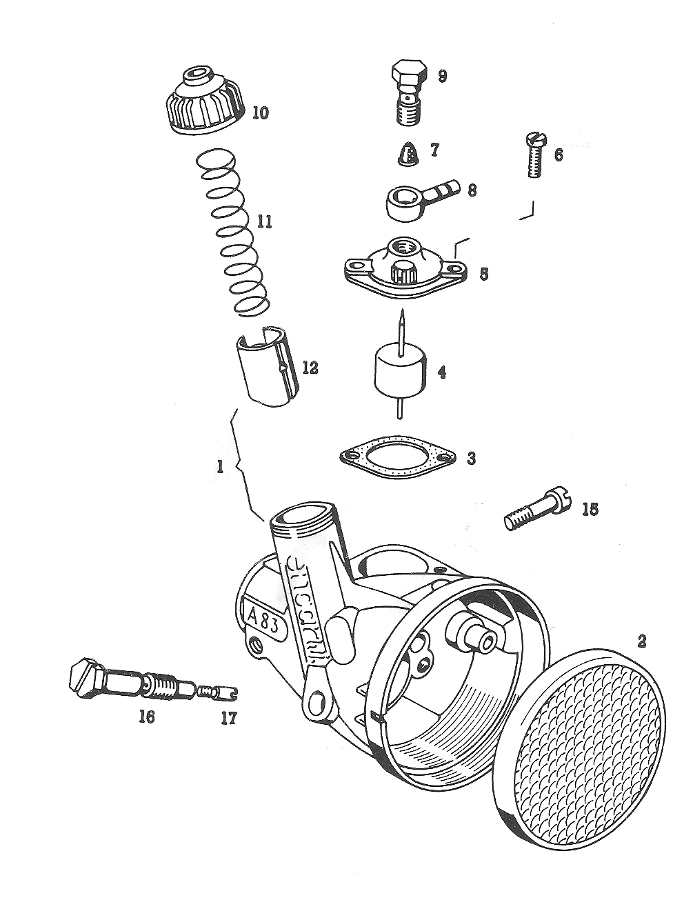
M48/M56 Batavus and Tomos A3 use Encarwi carbs. The wiki Encarwi page lists parts 1–17 (float, banjo, jet holder, etc.) and notes Bing jets may interchange — still verify on your carb; performance tuning treats Encarwi numbers as their own scale.
Fuel system — fix delivery before jetting
Rusty tank bikes need fuel path work first: clean/disassemble petcock, swap plastic pickup for 1½″ brass (½″ reserve), big inline filter, fresh line, confirm flow at the carb. Pull carb only after reeds and flange gaskets look sound.
Encarwi S25 teardown is a specific bolt order (choke cable, spanner nut, banjo screen, bowl screws). Do not soak float, O-rings, or banjo screen in carb cleaner. Some builders drill a controversial 1/16″ bowl vent above the choke — document before/after if you try it.
Exhaust mods (26 mm M48 system)
For the 26 mm M48 exhaust: de-restrict stock first, then the community weld/cut mod (die, tee nut, steel tubes, MIG — full parts list on the wiki). De-carbonize before cutting. Re-jet and re-float after any flow change.
MLM bolt-on for Starflite-class bikes via Treatland — pair with clutch and jetting, not a solo fix.
Clutch mods & repair
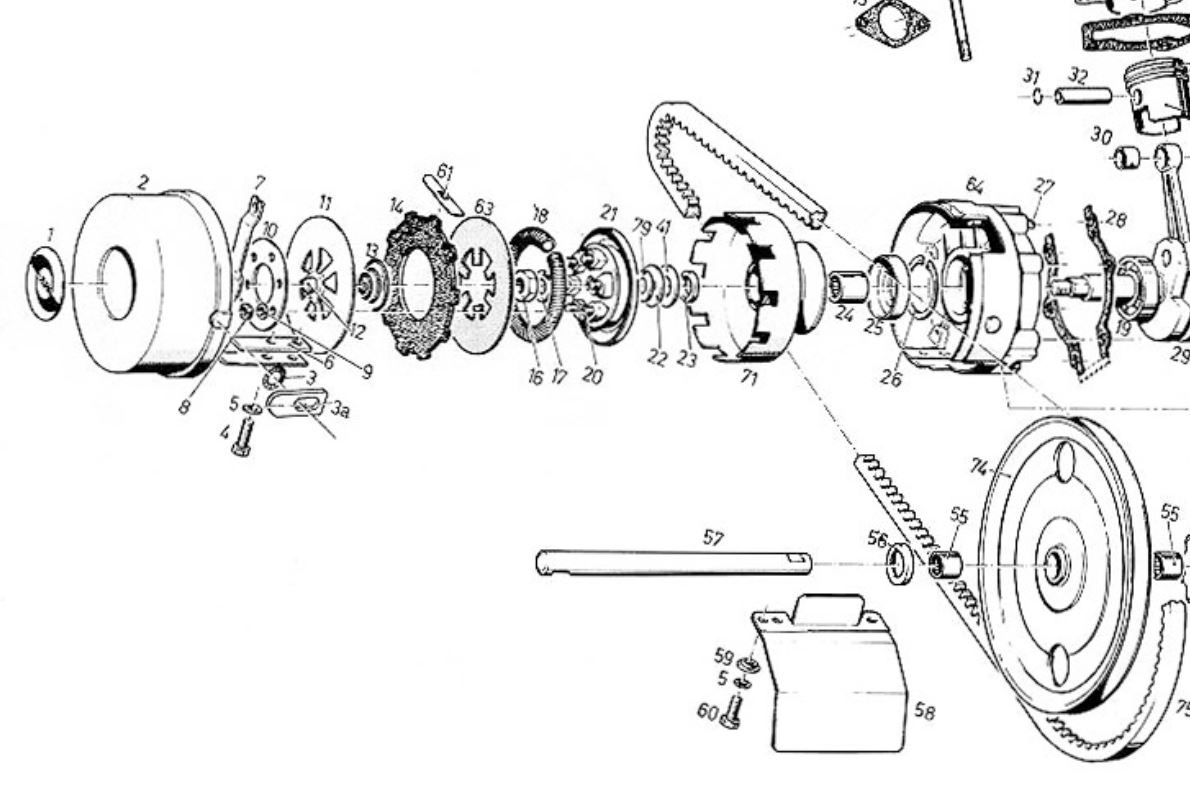
The M48 centrifugal clutch is not Puch shoes. The crank spins the clutch hub (#21); a coiled clutch spring (#18) lives in the hub groove. As RPM rises the spring expands outward along a ramped radius, pushing the pressure plate (#63) into the clutch plate (#14), which is splined to the clutch housing (#71) and ultimately the V-belt pulley (#74). Pedal starting uses the cable to compress the starter leaf spring (#7) from the opposite side — same parts, reversed torque path.
Service checks
- Disk gap 0.025″–0.125″ OK; over 0.150″ → disk or shim.
- Spring holds 31 × 7 mm bearings — ball-chain mods swap weight to raise engage RPM.
- ¼″ ball chain (0.250″–0.255″ OD best); twist spring 2½ turns, max gap ⅜″ installed.
Three community mod paths
| Mod | Media | Engage RPM |
|---|---|---|
| 1 — High | All ¼″ ball chain (~8–8⅜″) | Latest — race port / pipe builds |
| 2 — Mid | Chain segments + stock 7 mm bearings mixed | ~6,750 RPM street map sweet spot |
| 3 — Empty | No balls (not recommended long-term) | Can chatter, kink, destroy clutch |
Match clutch engage to your port map. High-RPM spring on a low-RPM cylinder feels dead off the line.
Clutch washer stack — low-end power leaks
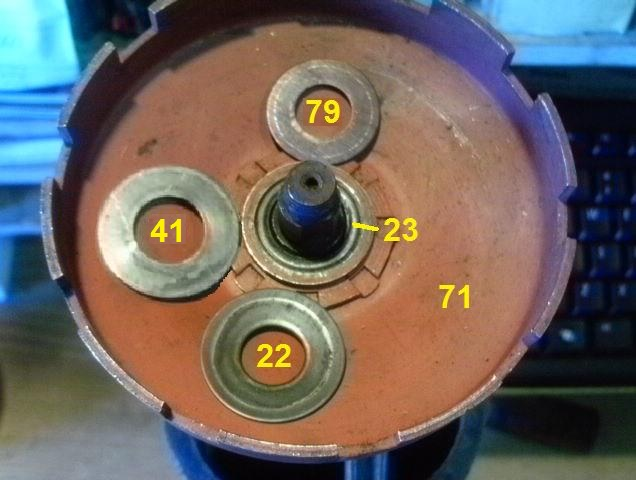
Rear wheel spins at idle? Big nut too tight. Weak off-the-line? Check washer stack order — #22 saucer spring dish faces up. Stack: felt #23 → washer #41 → saucer #22 → small #79 (red pulley bikes) → hub.
Bottom-end rebuild — bearings, seals, case split
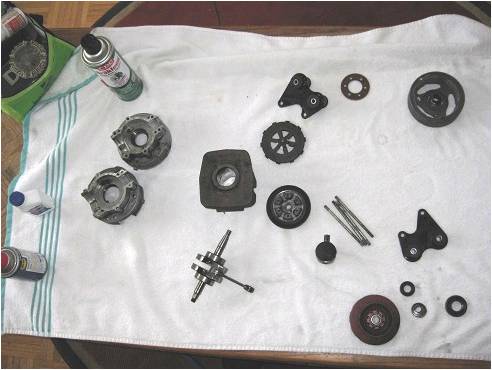
Photo every bolt before disassembly. Mark magneto position for timing. Case split: oven ~300°F, rubber mallet. Clutch hub: try puller before torch — heat can warp aluminum.
Reassembly — bearings into cases first
Not bearings onto crank first — heat case, freeze bearings, oil, slip in once. Seals after crank is fitted.
| Component | Dimension (wiki) |
|---|---|
| Crankshaft bearings | 42 × 15 × 13 — open cage visible (no seal between races; premix mist lubricates) |
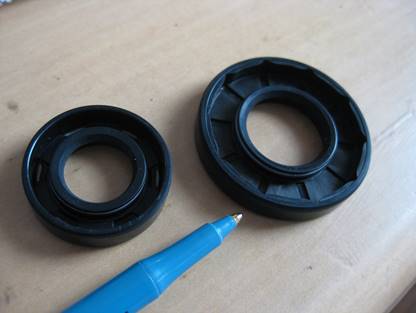
| Magneto-side crank seal | 30 × 15 × 7 |
| Clutch-side crank seal | 42 × 20 × 7 (larger ID — clutch hub passes through) |
Crankcase gasket: light 2-stroke oil. Head torque: 8 ft-lb in four steps (performance article).
Electrical & wiring diagrams
6V Bosch generator, magneto spark — no battery required for ignition. Turn-signal models need rack battery.
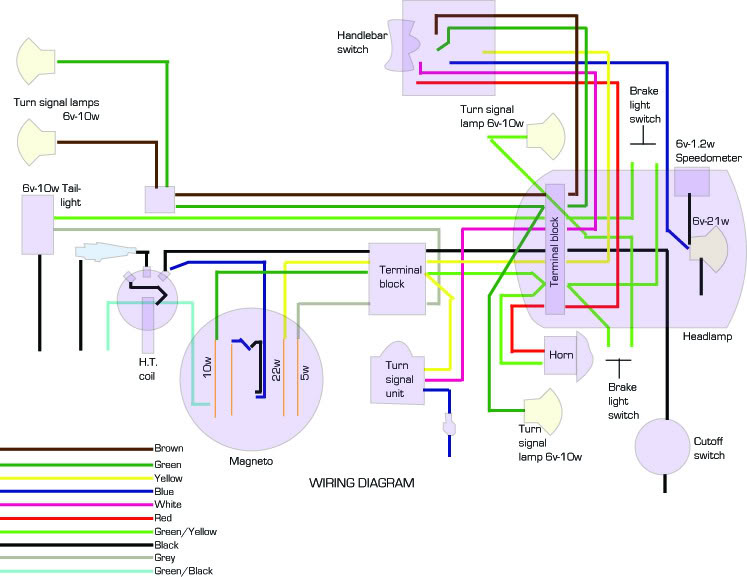
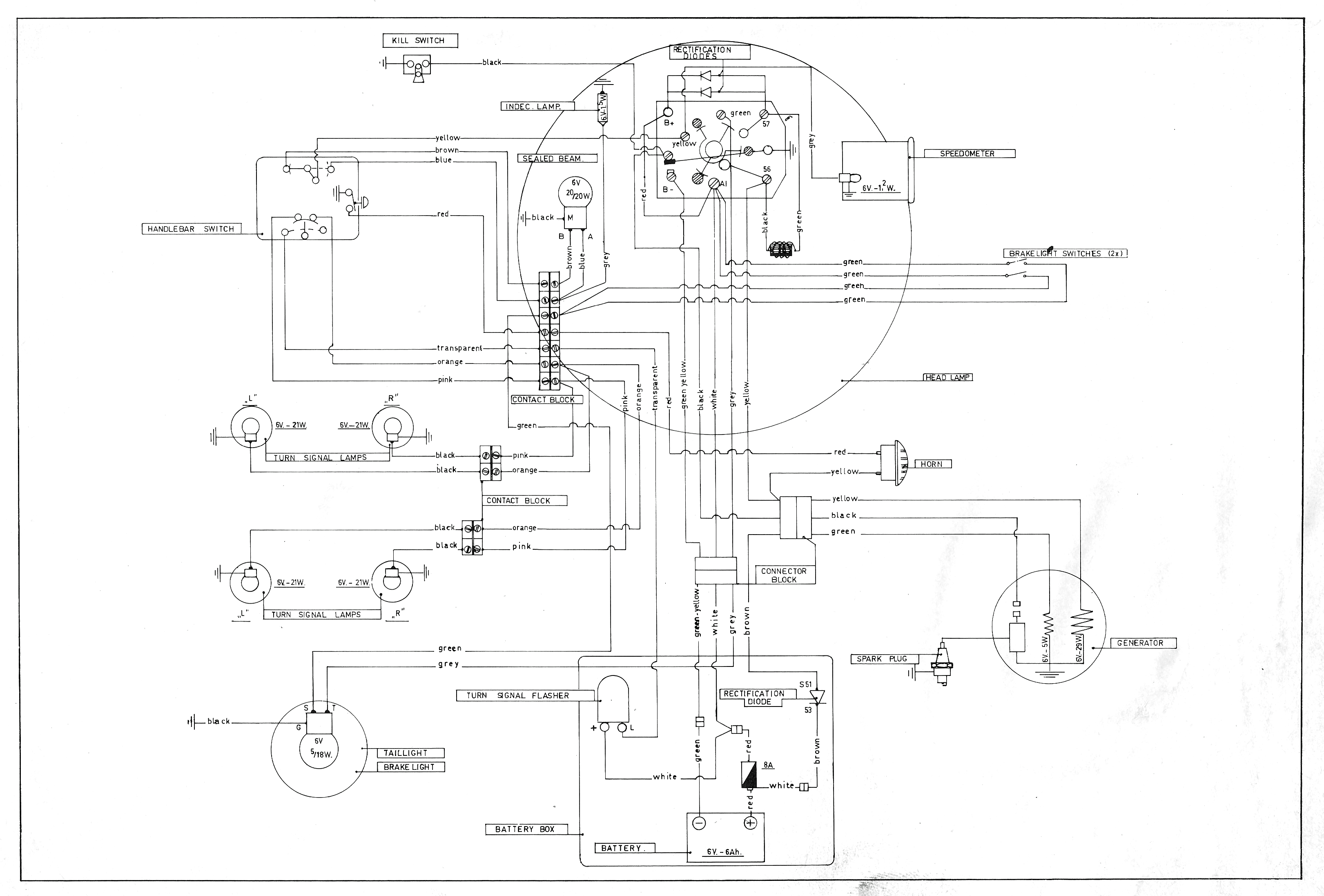
Additional VA/HS-50 diagram pages: photo credits · source files on HS-50 wiki.
Ignition & air leaks
US M48 bikes are overwhelmingly points + condenser. Weak spark mimics carb problems.
- Points gap — Start near factory spec on your plate; worn points wander timing at RPM.
- Condenser — Cheap fix for spark fade under load. Replace before you chase jets.
- Crank seals — The classic lean seize. Symptom: needs choke to idle, crisp at high RPM, dies hot. Pressure-test or replace seals before any kit.
- Intake leak — Encarwi stack must seal to the manifold. A split clamp without a proper gasket pulls air and leans the mix.
Cylinder port map — street band (4,500–7,000+ RPM)
Wiki street map targets peak power ~6,750 RPM with stronger low-end than the race map. Claimed ~4.0+ hp, 47.75 cc (40 mm bore × 38 mm stroke). Can run WOT all day on this map per community notes. Over 154–156° exhaust duration you lose low-end badly — one base gasket and ≤152° duration keeps grunt.
Street map power band (mph / RPM)
- Starts ~22 mph / 3,800 RPM
- Kicks in ~24 mph / 4,350 RPM
- Peaks ~37+ mph / 6,750 RPM
- Fades ~38 mph · four-stroke feel ~7,000 RPM = 39+ mph with stock carb/reeds
Carb & intake (street map)
| Carb | S-25 Encarwi — inlet 15×13 mm, venturi 12.2 mm, outlet 12.4 mm |
| Float | 12.5 mm pin tip to float top |
| Jet | S-25 #58–#62 |
| Alt carb | Dellorto SHA 14/12 — open air filter side to 16 mm, taper to 13.5 mm, jet #54–#58 |
| Stock intake mod | 12.4 mm in / 12.2 mm out → ~37 mph top |
| Hand-made S-25 intake | 13 mm in/out, machined reed block → ~39 mph |
| Hand-made SHA intake | 14.2 mm in/out, machined reed block → ~39 mph |
Reed & ignition (street map)
- Stock reed block — deburr, or swap to thin carbon reeds (Polini yellow .25 mm) with 4-40 fasteners after drilling rivets; remove center bridge for big two-petal setup.
- Optional 1/8″ shim between reed block and case so reeds open farther.
- Timing: 0.065″ ≈ 19° BTDC to 0.075″ ≈ 21° BTDC max. Stator plate mid-point +.
- Plug: NGK B8HS or BU8H, gap 0.017″–0.021″. Points gap 0.0155″–0.016″.
Cylinder & head (street map)
- Cut cylinder top 0.024″–0.044″ stopping at top cooling fin. Piston dome should rise 1 mm (0.039″) above cylinder at TDC.
- Minimum 16.6 mm (0.655″) between piston dome and spark plug gasket seat at TDC (tire tread depth gauge trick works).
- Mill head to keep plug tip ≥1 mm from piston at TDC. Target compression 9.4:1–9.6:1 max — higher risks ping and overheating.
- Head torque: 8 ft-lb (not 11) in four steps (2→4→6→8) in criss-cross pattern. One base gasket.
Exhaust port (street map — 152° duration)
| Duration | 152° |
| Opens | 104° ATDC / 25.5 mm (1.005″) piston travel from TDC |
| Height × width | 12.5 mm × 24.5 mm ovule (football) shape ≈ 60% bore width |
| Work | Polish; taper piston-side opening carefully — don't nick a ring |
Transfer ports (street map)
| Duration | 117° |
| Opens | 121.5° ATDC / 31 mm (1.220″) from TDC |
| Height × width | 7 mm × 17 mm — long teardrop pointing away from exhaust |
| Work | Point transfers 25° away from exhaust side; no taper toward exhaust; hand-polish last 0.5 mm |
Cross-check cuts with the port timing calculator (stroke 38 mm).
Cylinder port map — race band (5,100–7,400+ RPM)
| Power band | 5,100 – 7,400+ RPM, peak 7,125 RPM |
| Displacement | 47.75 cc · 40 mm bore · 38 mm stroke |
| Exhaust duration | 164° — opens 98° ATDC / 24.3 mm / height 13.7 mm × width 25 mm |
| Transfer duration | 120° — opens 120° ATDC / 30.5 mm / height 7.5 mm × width 17 mm |
| Low-end vs stock | Weaker off-the-line, ~32%+ more top-end (community claim) |
Reference photos
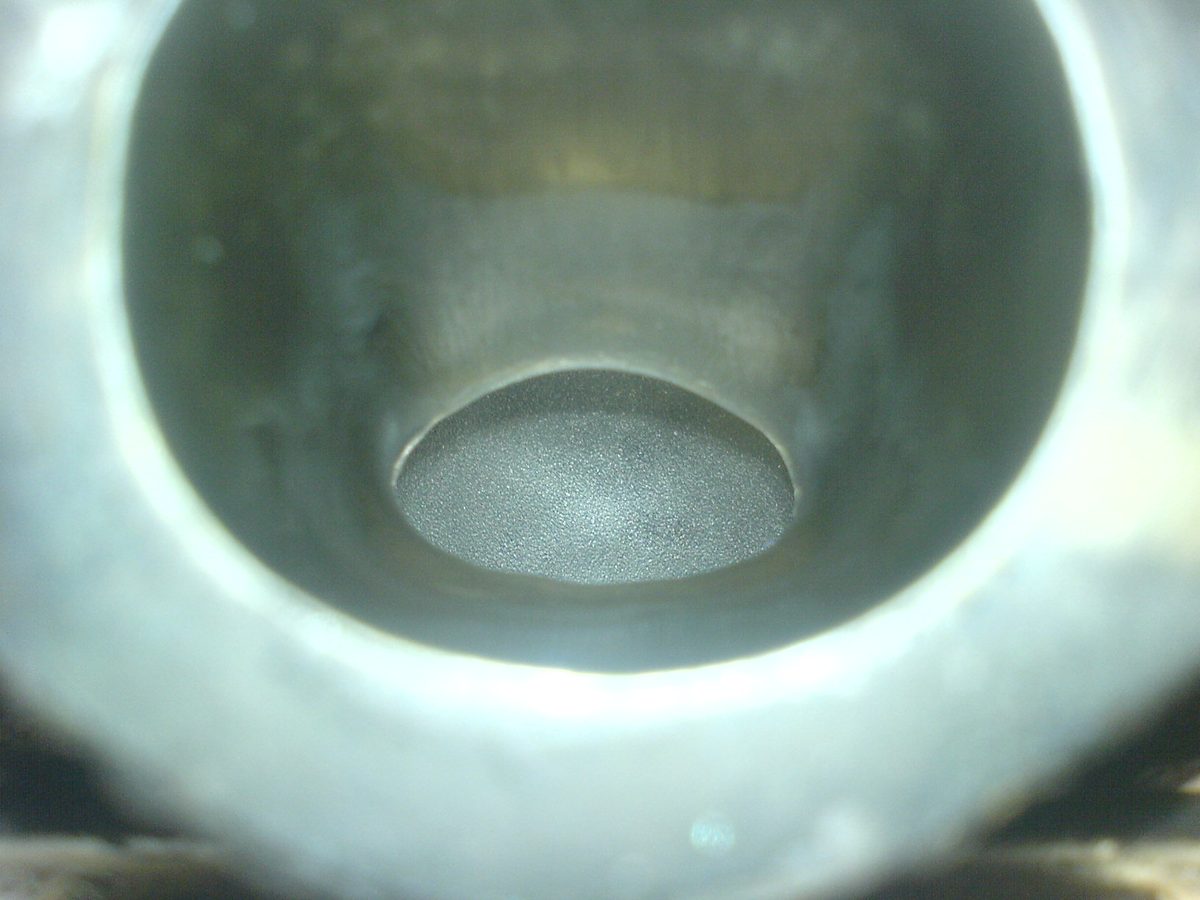
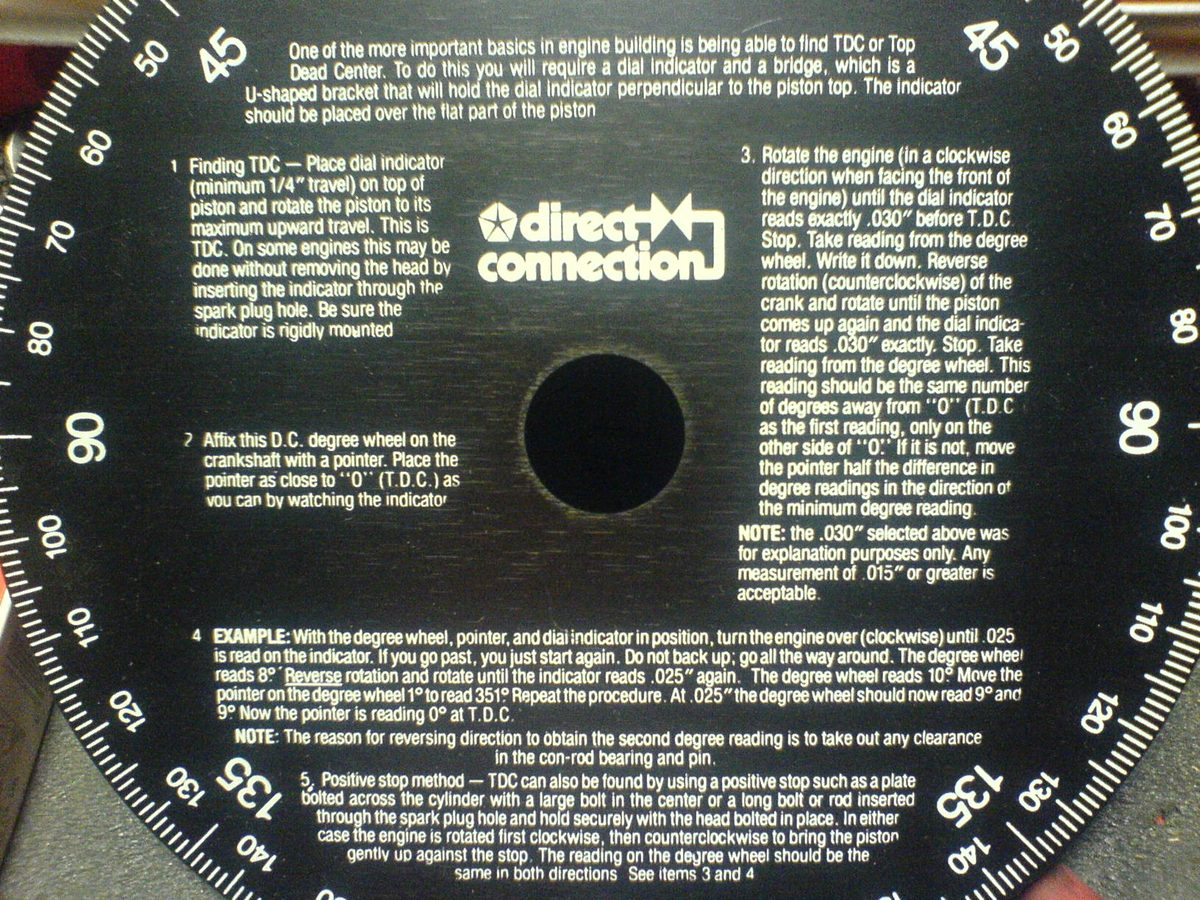
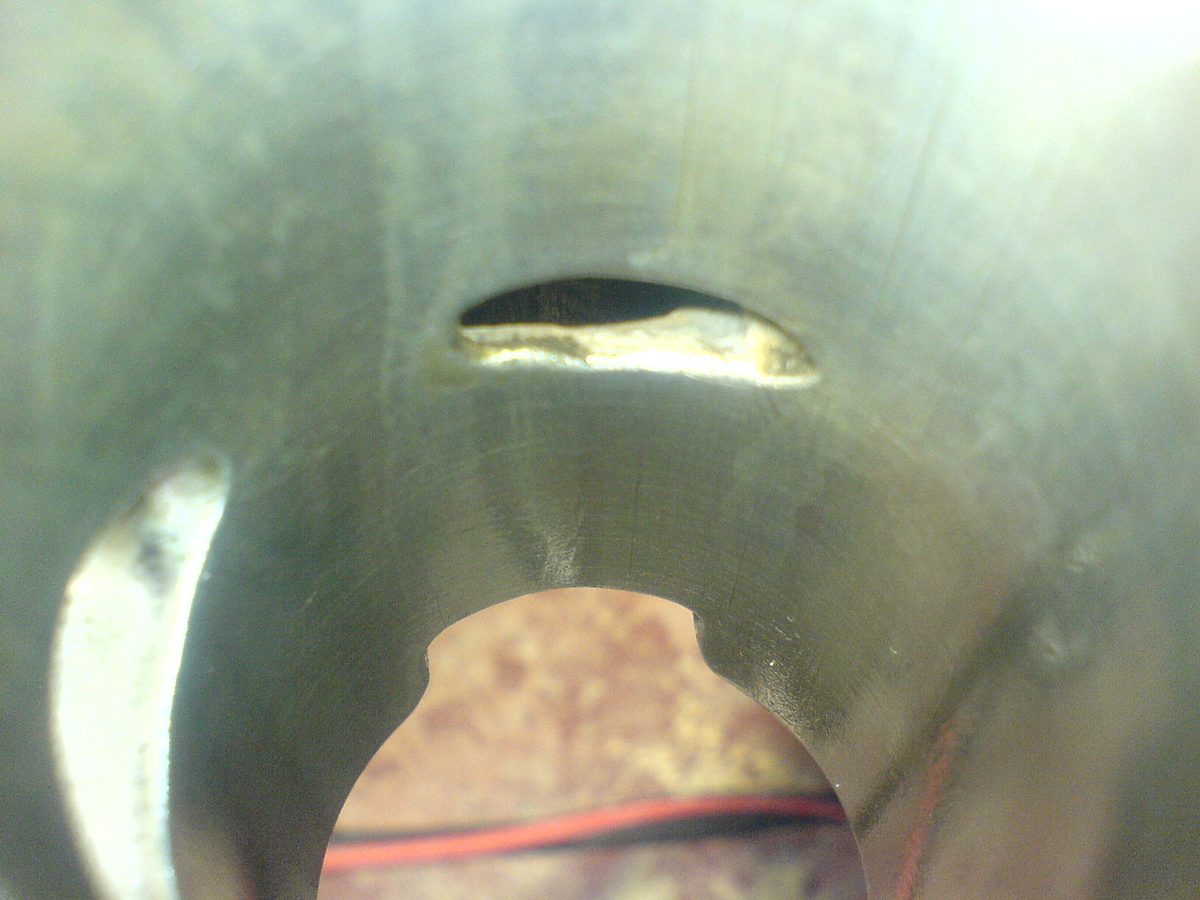
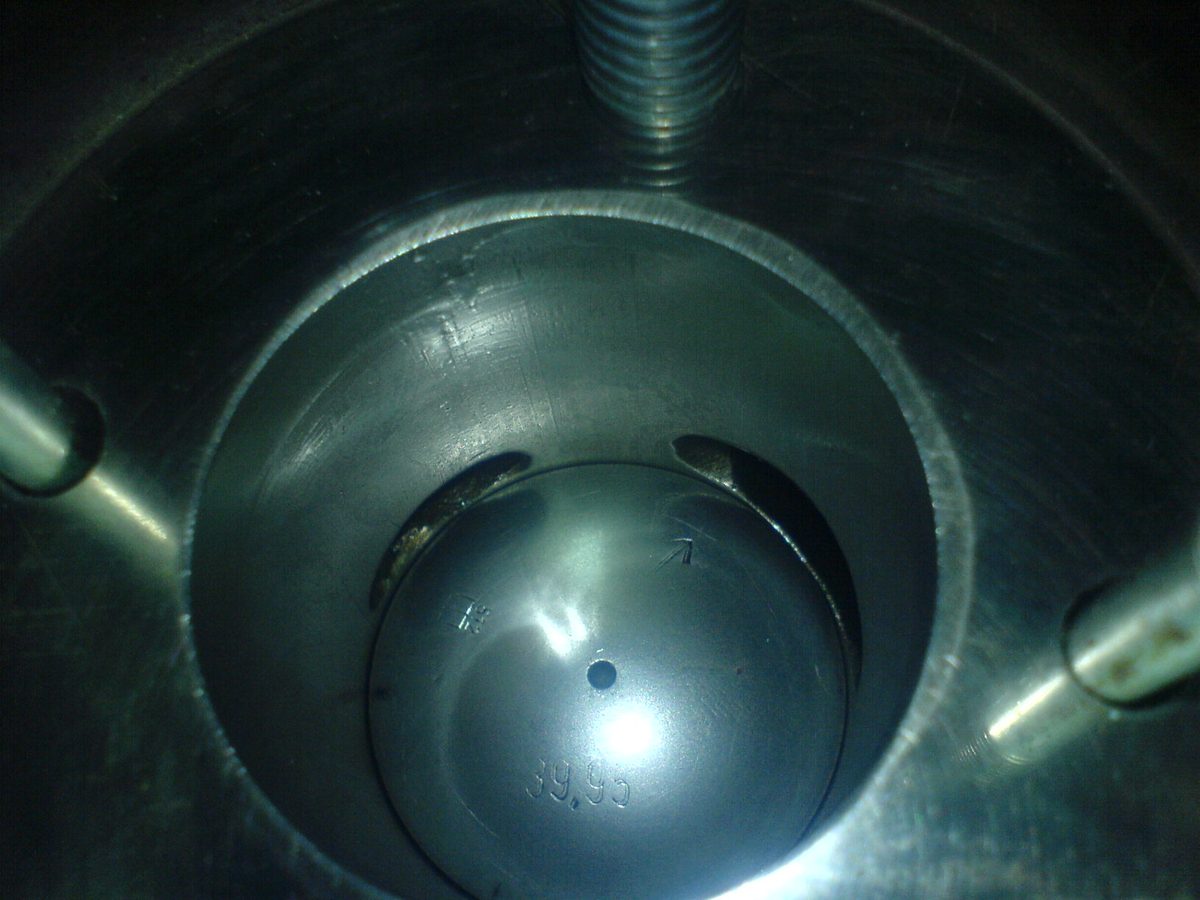
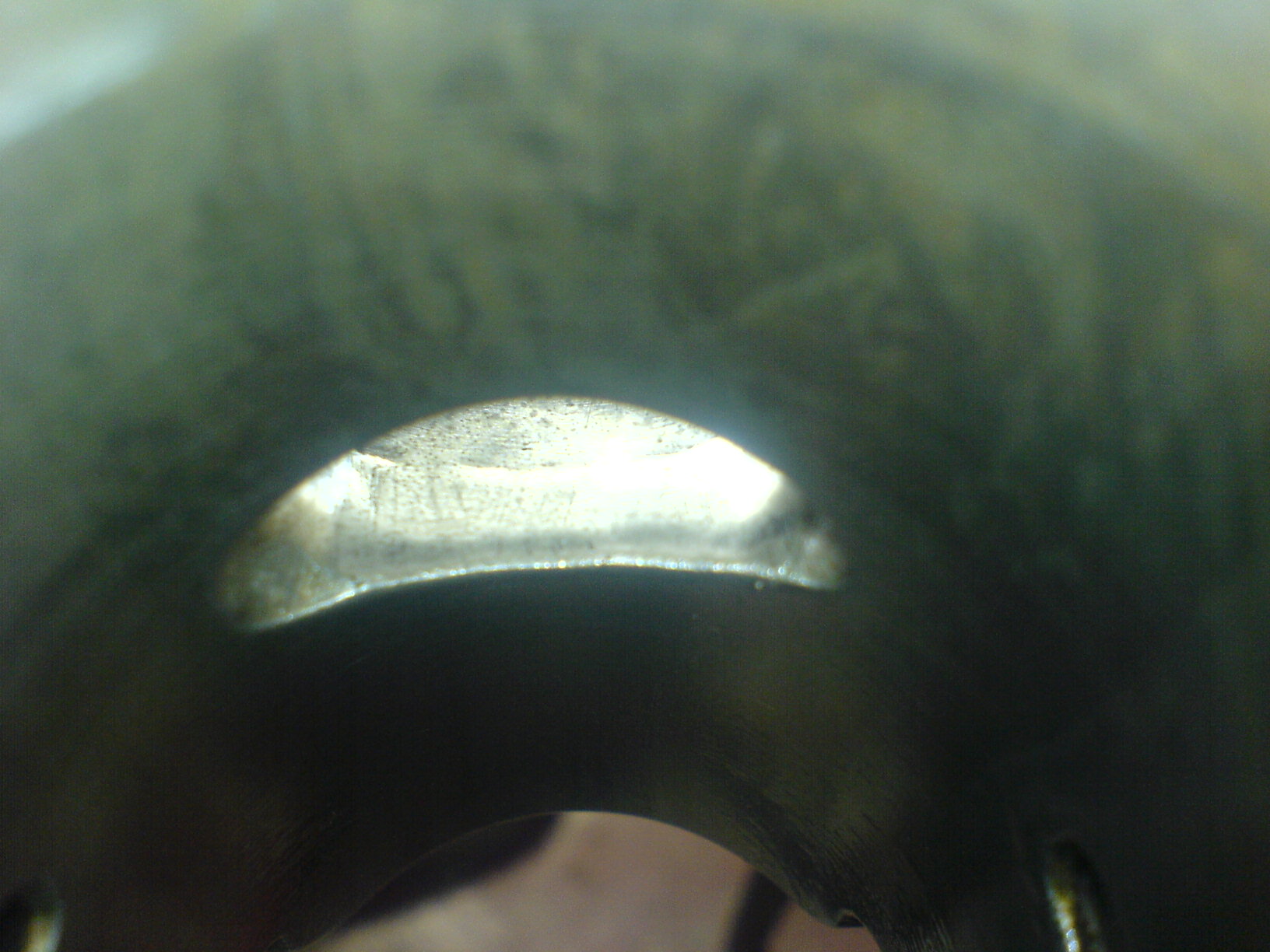
Sample images from the community build gallery — full set (16 photos, port-mod progression) lives on the wiki.
Three build paths (M48 edition)
★ Mild — daily rider
- New belt, correct tension
- Float set, carb ultrasonically clean
- Fresh plug, points set, condenser if old
- Stock exhaust leak-free
- 50:1 quality synthetic premix
★★ Mid — spirited commuter
- 26 mm exhaust de-restriction or MLM pipe + #58–62 jet / 12.5 mm float
- Clutch Mod 2 (ball chain + bearings) for ~6,750 RPM band
- Fuel system spotless — brass pickup, big inline filter
- Street port map lite: polish ports, deburr reeds, 19–21° BTDC
★★★ Wild — wiki race map territory
- Clutch Mod 1 (all ball chain) for 7,000+ RPM engage
- 164° exhaust / 120° transfer map — oversize piston or low gearing required
- Head mill + squish check (9.4:1–9.6:1 max), 8 ft-lb torque sequence
- Degree wheel every cut — gallery photos above are your template
Troubleshooting cheat sheet
| It does this | Check this (in order) |
|---|---|
| Revs, slow speed, hot smell | Belt slip → clutch slip → jetting |
| Starts, won't stay running hot | Air leak / crank seal → float flood → coil |
| Rich plug, black exhaust | Float high → main jet → choke stuck |
| Lean plug, piston score | Seal leak → main too small → belt dragging |
| One speed only, no shift issue | Correct — M48 is single speed. Stop looking for a shifter. |
Manuals, videos & sources
Read the full tutorials on the wiki — this vault is the cheat sheet, not the textbook. See also copyright policy.
- Batavus performance · HS-50 · M48 · Rebuild guide · Encarwi · Clutch washers · Intercycle history
- Project Moped Manual — Batavus index
- Moped Army — Laura M48 / M56 wiki
- Batavus Repair video series — clutch mod, Encarwi carb, tools (wiki linked)
- Old School M48 tech notes (PDF)
- Lamborn's Miniature Engines — M48/M56 stock & mod info
- YouTube — M48 exhaust mod walkthrough (wiki referenced)
- MopedMasters manuals row →