Exhaust port work is the single biggest change you can make to a single-exhaust-port moped cylinder — Puch E50, Tomos A35, Minarelli V1, Sachs 505, Morini, and most 49–70cc air-cooled jug upgrades. Done well, porting moves the powerband up, lets a pipe breathe, and unlocks kit potential. Done poorly, it costs low-end torque, burns pistons, and leaves you jetting forever with no RPM gain.
This guide covers why porting works, how to measure before you cut, how to shape a single exhaust port for street or race, fuel and octane choices, and how to use the port timing calculator for duration and blowdown.
Introduction — why exhaust porting matters
The exhaust port controls when burnt gas leaves the cylinder and how much cross-sectional area is available at each crank angle. On a typical moped single-port cylinder, the exhaust is a rectangular or oval window in the upper bore. Raising the roof (port height), widening the port, or reshaping chamfers changes:
- Exhaust duration — degrees of crank rotation the port is open
- Blowdown — time after BDC the port stays open on the upstroke (duration − 180°)
- Time-area — flow capacity integrated over the open period (critical for pipe match)
- Scavenging balance — how well fresh charge can enter after exhaust blow-down
Benefits: more top-end RPM, better pipe efficiency, cooler EGT at the same speed when matched to carb and ignition, and meaningful gains on kitted 60–70cc builds.
Risks: lost cylinder pressure at low RPM, short-circuiting (fresh charge out the exhaust), overheating, ring snagging on sharp edges, seizures on automatic-clutch bikes if blowdown is excessive, and pistons that die in 200 miles from a ragged chamfer.
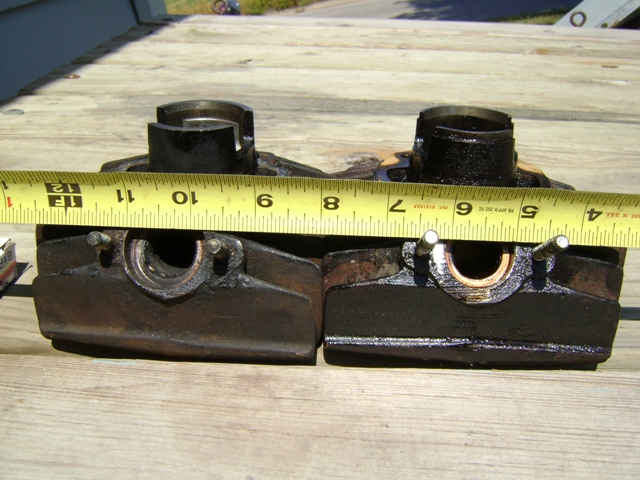
Fundamentals — duration, time-area, blowdown & scavenging
Port timing & duration
Port timing is the crank angle at which a port opens and closes relative to TDC/BDC. Exhaust duration is the total degrees the exhaust port is open per cycle. On piston-ported mopeds you usually measure exhaust port height (E) — distance from the cylinder deck down to the top edge of the port — and convert to duration using piston geometry (Graham Bell formula; see duration calculator).
Blowdown
Blowdown = exhaust duration − 180°. It represents how long the exhaust port remains open after the piston passes BDC on the upward stroke. More blowdown dumps cylinder pressure faster before the compression stroke — good for high RPM, bad for crawl-off-the-line torque on a heavy pipe.
Time-area
Time-area combines port cross-section with how long it is open. A wide but short port can flow less total gas than a narrower port that stays open longer. Professional tuners map time-area curves; for moped work, track port width × port height and duration together as a before/after index (our calculator shows a simplified time-area index).
Powerband effects
| Change | Low-end / torque | Mid-range | Top-end / RPM | Scavenging |
|---|---|---|---|---|
| Raise exhaust roof (+E) | ↓ weaker | shifts up | ↑ later peak | risk of short-circuit if transfers lag |
| Widen exhaust | ↓ slight | ↑ flow | ↑ if pipe matches | needs richer jetting |
| More blowdown | ↓ | narrower | ↑ peak RPM | pipe must pull harder |
| Rounded chamfers | neutral | ↑ efficiency | ↑ ring-safe RPM | less turbulence at port edge |
Typical duration targets (single-port moped)
| Setup | Exhaust duration | Blowdown | Peak RPM band | Notes |
|---|---|---|---|---|
| Stock 49cc commuter | 138–150° | 0–12° | 4,500–6,000 peak | Puch 1 HP, restricted Sachs; under ~30 mph class |
| Derestricted / mild pipe | 162–168° | 15–22° | 8,000–9,000 peak | Tomos SHA, Puch 2 HP + Bi-Turbo |
| Piped street / 70cc kit | 169–175° | 22–28° | 9,000–10,000 peak | Airsal 70, Metrakit; best all-around band |
| High-RPM street / race | 176–182° | 28–32° | 10,200–11,200 peak | Weak under 5K; needs pipe + clutch |
| Aggressive race / reed | 183–187°+ | 32–40°+ | 11,500–13,500 peak | Polini, Athena AJH; expert tune only |
Automatic centrifugal-clutch engines (Puch E50, Minarelli V1, ZA50) often hate excessive blowdown — the engine revs past the clutch engagement window before making usable wheel torque. Treat duration tables as targets, not guarantees.
Port timing calculator
Log your bore, stroke, rod, deck height, port width, and port height in the dedicated calculator — it returns duration, blowdown, an illustrative powerband, and a scaled cross-section diagram. Puch E50 uses a 42 mm stroke crank; older forum charts assumed 43 mm.
T = R + L + C − E (R = stroke ÷ 2) → D = (180 − cos⁻¹((T² + R² − L²) / (2RT))) × 2
How to measure exhaust port duration & map the port
Tools you need
- Degree wheel or printable degree tape on the flywheel
- Piston stop or long-reach plug to find TDC accurately
- Dial calipers or quality digital calipers (0.01 mm resolution helps)
- Straightedge & feeler gauges for deck and squish checks
- Permanent marker / machinist dye for scribing port edges
- Notebook — log every dimension before cutting
- Optional: radius gauges, bore scope, port mapping software (Bimotion-style concepts)
Method A — measure port height E (most common on mopeds)
- Install the cylinder on a bare piston/crank or in the engine with piston at TDC.
- Measure C — piston crown to cylinder deck (deck height).
- Measure E — cylinder deck down to the top edge of the exhaust port (consistent reference point).
- Enter stroke, rod, C, and E in the port timing calculator.
- Cross-check: rotate the crank and verify when the piston crown uncovers the port — should align within a degree or two.
Method B — degree wheel on the crank
- Find TDC with a piston stop; mark TDC on case and wheel.
- Rotate slowly — mark the crank angle where the piston uncovers the exhaust port (open) and where it covers it (close).
- Duration ≈ (180 − open° before TDC) + (180 − close° after BDC) for a symmetric port — or sum the measured open period directly.
- Compare to the geometric formula — large gaps mean rod length or deck measurement is wrong.
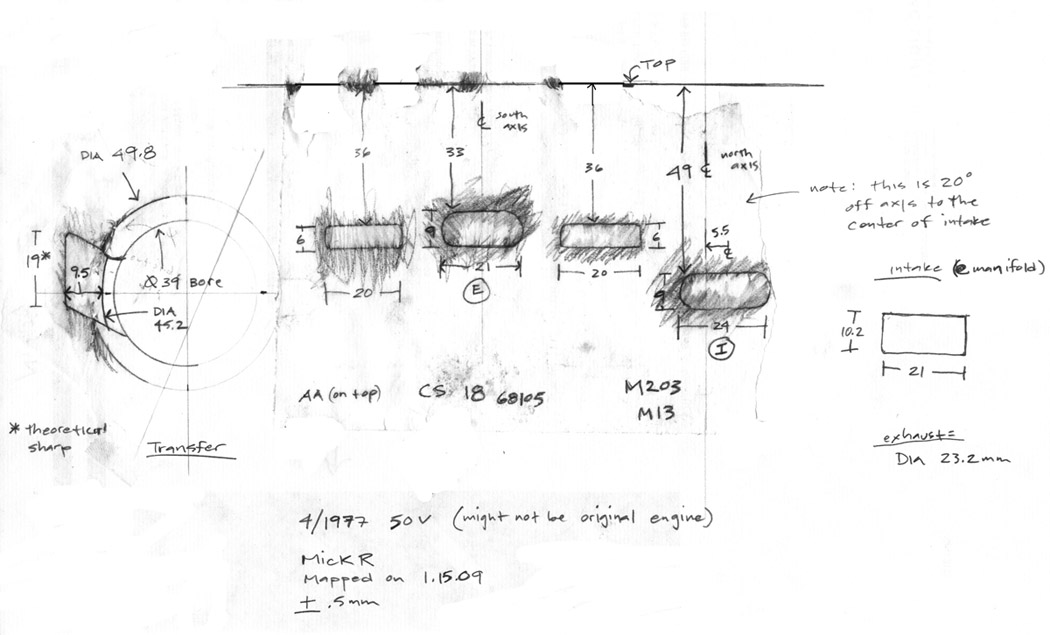
Port mapping (width, shape, floor)
- Measure port width at the roof, mid-wall, and floor — many stock ports taper.
- Express width as % of bore (street: often 65–75%; race singles: 70–85% depending on stroke class).
- Sketch the port profile on graph paper or take a photo with a scale ruler.
- Measure chamfer radius on the roof — sharp roofs snag rings.
Common measuring pitfalls
- Measuring port height from the wrong edge (gasket seat vs deck surface).
- Using a screwdriver in the plug hole for TDC — use a stop.
- Ignoring base gasket thickness — changes effective deck and transfer timing.
- Mixing up rod lengths between platforms (Puch 90 mm vs Tomos/Minarelli 85 mm).
- Counting casting flash as the port edge — deburr first, then measure.
Step-by-step exhaust porting (single port)
Work on a cold cylinder, clamped rigidly. Go slow. Remove material in small passes; you cannot put metal back without welding.
1. Baseline & goal
- Log stock E, width, chamfers, duration, compression, carb jet, and pipe.
- Pick a duration target from the table above for your use (street vs race).
- Confirm piston ring position at TDC/BDC — never cut into ring travel.
2. Raise the roof (port height)
Raising the exhaust roof is the primary way to add duration. Typical moped increments:
- Street / mild: 1–2 mm off the roof — often 5–12° duration gain
- Piped 70cc: 2–4 mm total from stock casting — verify ring clearance
- Race: cut to mapped profile; match transfer timing and pipe
Use a carbide burr, die grinder, or files; finish with sanding rolls. Keep the roof flat or slightly upward toward the bore center — avoid hooking downward into the piston path.
3. Widen the port
Widen in moderation. Start with 1–2 mm per side on street builds. Target 65–72% of bore for friendly street manners on 38–40 mm bores; 70cc kits often run 70–78% with a matched pipe.
4. Shape — roof, waist, floor, chamfers
- Top edge: radius 2–4 mm on street; larger radii for race RPM and ring life.
- Waist / taper: many fast ports are widest at the roof and taper toward the floor to preserve crankcase volume.
- Floor: do not lower the floor unless you understand transfer timing — lowering increases duration differently than raising the roof and can expose the piston skirt early.
- Chamfers: break every sharp edge; polish the first 3–5 mm into the port throat only — mirror-polish the whole tract can hurt atomization.
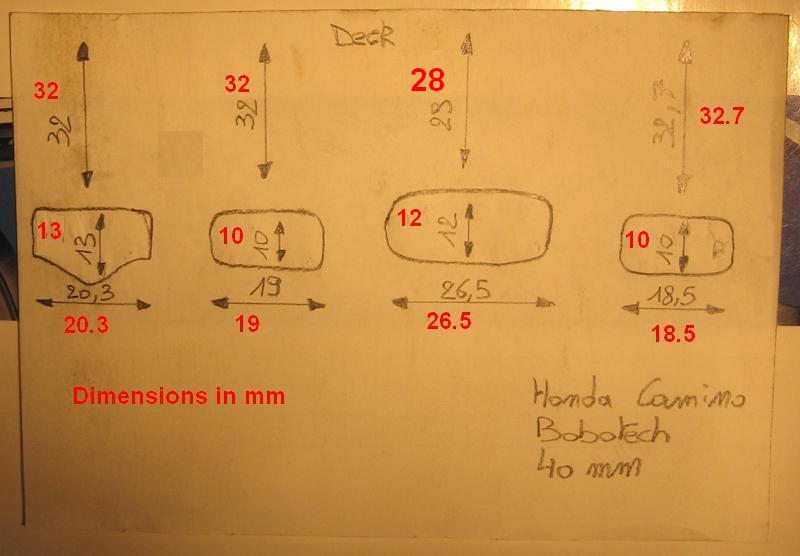
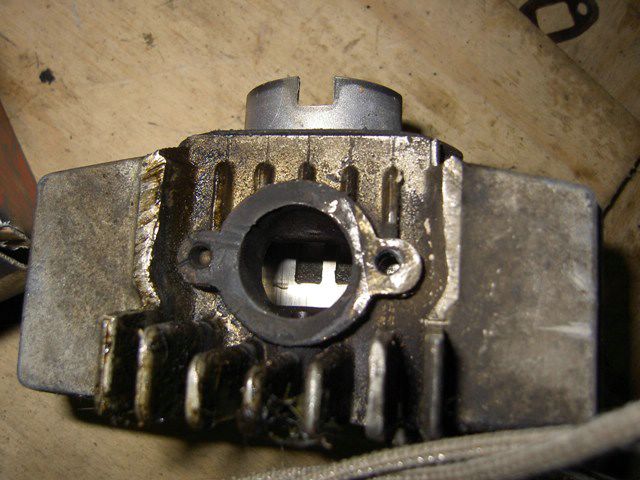
Shape matters as much as size — radius the roof, verify ring clearance at TDC before setting final port height.
5. Blend & finish
- Blend the port into the combustion chamber with a smooth radius — no ledges.
- Deburr the transfer side of the wall if you cut through to casting flash.
- Wash the cylinder; inspect for sand or filings.
- Re-measure E and width; rerun the port timing calculator.
6. Before/after checklist
- Duration and blowdown within target
- Ring clearance verified at TDC and 10° before/after
- Transfers not accidentally opened into the exhaust wall
- Head gasket and squish rechecked if deck was touched
- Jetting stepped richer; plug chop scheduled
Effects of port changes — powerband, pipe, compression, ignition
Low-end & mid-range
More duration and blowdown bleed cylinder pressure before the crank completes the upstroke — the engine feels lazy off idle unless pipe and carb compensate. On piped bikes, a fat midrange often comes from pipe + moderate blowdown, not maximum port height alone.
Top-end
Higher duration lets the engine rev where the pipe wants to resonate. Without a matched expansion chamber, a big port mostly loses torque. Pair port work with our pipe designer.
Short-circuiting
If the exhaust is still open when strong transfer flow begins, fresh charge escapes out the exhaust — four-stroking, spooge, and overheating. Fixing it means transfer/exhaust timing balance, reed timing (on reed bikes), or less aggressive exhaust duration.
Transfers, compression & ignition
- Opening transfers without exhaust coordination can wash oil and overheat the piston crown.
- Removing head gasket material raises compression — porting + compression + lean jet = seizure.
- More aggressive porting usually wants slightly retarded ignition on kitted aluminum (often 14–14.5° BTDC on Puch; see platform guides).
Fuel considerations — pump gas vs race fuel (AV gas)
Porting increases heat and cylinder pressure at a given RPM. Fuel choice affects detonation margin, plug color, and bearing life.
| Fuel | Typical octane | Best for | Notes |
|---|---|---|---|
| 87 AKI pump (US regular) | 87 | Stock & mild street porting | Fine for low-compression cast iron with conservative timing; ethanol blends shorten storage life. |
| 91–93 AKI premium pump | 91–93 | Mild–mid ported + pipe | Default recommendation for most kitted 70cc street builds with correct jetting. |
| Race gas 100–105 AKI | 100–105 | High compression / hot setups | More detonation headroom; expensive for daily riding; still needs correct jetting — octane does not fix lean. |
| AV gas / methanol blends (e.g. 110+) | 110+ MON typical | Race porting, high RPM | Different stoichiometry — must rejet; some blends are leaded (check plug/lambda); not for cats or street legal in many areas. |
Octane, detonation & jetting
- Octane resists detonation; it does not add power unless you were detonating on lower octane.
- Heavily ported engines show detonation as silvery spots on the piston, eroded plug electrodes, or loss of power when hot.
- Race fuels burn slower — you may need different main jets and timing vs pump gas.
- Lead: leaded race gas protects valve seats (irrelevant on sleeve moped cylinders) but fouls plugs and is illegal on public roads in the US.
- Storage: pump E10 absorbs water; race gas in sealed cans ages better but still degrades.
Recommendations by port level
- Mild street port (165–175°): 91 AKI pump, 40:1–50:1 premix, B6HS/B7HS class plugs — chop and read.
- Piped 70cc (170–180°): 93 AKI minimum in hot climates; 32:1–40:1 on fresh kits; watch plug color at WOT.
- Race / max blowdown: race gas only if compression, pipe, and dyno show need; retune jets from scratch; colder plugs; monitor head temp.
Tools, best practices, common mistakes & advanced tips
Recommended tools
- Die grinder + carbide burrs (non-ferrous cylinder) or stones (cast iron)
- Files, emery rolls, Scotch-Brite
- Masking tape and Sharpie for depth marks — cut to the tape line
- Shop vac while cutting — do not inhale nicasil or chrome dust
Best practices
- Cut less than you think; measure twice.
- Match pipe, carb, clutch to the new RPM band.
- Break in gently — new ring bedding on a fresh chamfer.
- Log changes in mm and degrees, not “a little bit.”
Common mistakes
- Maximum port + stock pipe + stock jetting.
- Sharp 90° roof edges → ring hang and scuffing.
- Ignoring automatic clutch engagement RPM on Puch/Tomos/Minarelli.
- Porting a 1 HP restricted Puch without fixing intake restrictions first.
- Lowering the port floor without transfer math.
Advanced tips
- Squish band: aggressive roof cuts can reduce squish — measure squish clearance after porting.
- Boost ports / bridges: on multi-port kits, exhaust timing still sets the ceiling — do not orphan transfer work.
- Cylinder deck resurface: shaving the deck raises port timing on all ports — recalculate everything.
- Compare to kit maps: Airsal, Polini, and Metrakit publish approximate durations — use as guardrails.
Safety, maintenance & legal notes
- PPE: safety glasses, respirator for grinding, gloves.
- Fire: aluminum fines are flammable when fine — keep shop clean.
- Maintenance: after porting, shorten plug check intervals; inspect piston crown and ring end gap every few hundred miles on race setups.
- Legal: modified exhausts, displacement changes, and derestricted engines may affect registration class, insurance, and trail access. Know your state rules — see 50cc laws.
- Emissions: removing baffles or increasing displacement may violate federal or state equipment laws even if the bike is old.
Conclusion & next steps
Exhaust porting on a moped single is the bridge between a stock jug and a coherent performance build. Measure first, cut second, then match carb jetting, pipe length, clutch engagement, and ignition timing to the new RPM band.
- Log baseline dimensions in the port timing calculator.
- Plan duration target vs your pipe and platform — Puch, Tomos, Minarelli V1 builds.
- Jet with plug chops — carb jetting guide.
- Design or verify pipe dimensions — expansion chamber designer.
- Premix and break-in — oil mix chart.
Questions on a specific cylinder? Bring your before/after numbers to live chat — duration, width, jetting, and pipe together tell the story.